
Orhan, Ezgi
Loading...
Profile URL
Name Variants
Orhan, E.
Orhan, Ezgi
Orhan, Ezgi
Orhan, Ezgi
Orhan, Ezgi
Orhan, Ezgi
Orhan, Ezgi
Orhan, Ezgi
Orhan, Ezgi
Job Title
Doç. Dr.
Email Address
ezgiorhan@cankaya.edu.tr
Main Affiliation
05.03. Şehir ve Bölge Planlama
05. Mimarlık Fakültesi
01. Çankaya Üniversitesi
05.03. Şehir ve Bölge Planlama
Şehir ve Bölge Planlama
05. Mimarlık Fakültesi
01. Çankaya Üniversitesi
05. Mimarlık Fakültesi
01. Çankaya Üniversitesi
05.03. Şehir ve Bölge Planlama
Şehir ve Bölge Planlama
05. Mimarlık Fakültesi
01. Çankaya Üniversitesi
Status
Current Staff
Website
ORCID ID
Scopus Author ID
Turkish CoHE Profile ID
Google Scholar ID
WoS Researcher ID
Files
Sustainable Development Goals
13
CLIMATE ACTION

3
Research Products
8
DECENT WORK AND ECONOMIC GROWTH

2
Research Products
3
GOOD HEALTH AND WELL-BEING

1
Research Products
15
LIFE ON LAND

0
Research Products
17
PARTNERSHIPS FOR THE GOALS

2
Research Products
14
LIFE BELOW WATER

3
Research Products
4
QUALITY EDUCATION

0
Research Products
11
SUSTAINABLE CITIES AND COMMUNITIES

18
Research Products
6
CLEAN WATER AND SANITATION

0
Research Products
10
REDUCED INEQUALITIES

0
Research Products
9
INDUSTRY, INNOVATION AND INFRASTRUCTURE

1
Research Products
12
RESPONSIBLE CONSUMPTION AND PRODUCTION

0
Research Products
2
ZERO HUNGER

0
Research Products
1
NO POVERTY

2
Research Products
7
AFFORDABLE AND CLEAN ENERGY

0
Research Products
5
GENDER EQUALITY

1
Research Products
16
PEACE, JUSTICE AND STRONG INSTITUTIONS

0
Research Products

Documents
15
Citations
110
h-index
7

Documents
21
Citations
121

Scholarly Output
28
Articles
22
Views / Downloads
1541/3453
Supervised MSc Theses
2
Supervised PhD Theses
0
WoS Citation Count
42
Scopus Citation Count
33
WoS h-index
5
Scopus h-index
4
Patents
0
Projects
0
WoS Citations per Publication
1.50
Scopus Citations per Publication
1.18
Open Access Source
17
Supervised Theses
2
Google Analytics Visitor Traffic
| Journal | Count |
|---|---|
| İdealkent | 4 |
| Journal of Planning | 4 |
| Planlama | 2 |
| Cities | 1 |
| Earthquake Spectra | 1 |
Current Page: 1 / 4
Scopus Quartile Distribution
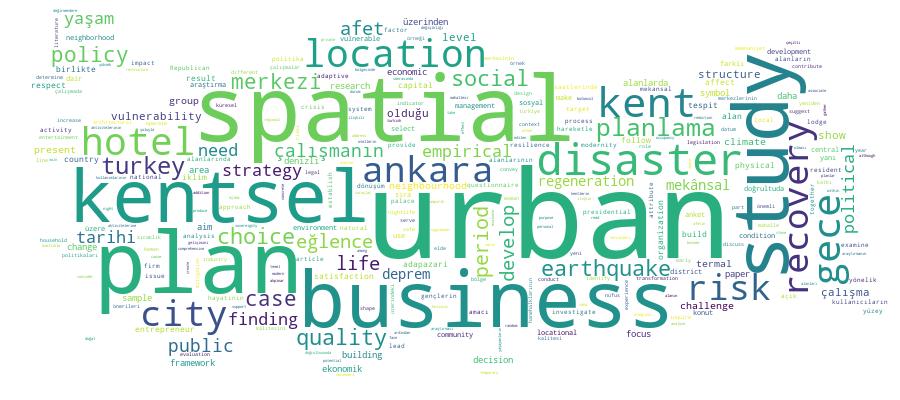
Competency Cloud
28 results
Scholarly Output Search Results
Now showing 1 - 10 of 28
Master Thesis The Location Choice of Urban Nightlife Activities and Their Impact on City Centers: the Case of Denizli City(2024) Yılmaz, Gökçe; Orhan, EzgiKentlerin ve merkezi alanların gelişimini yönlendiren çeşitli faktörler, zaman içinde kent merkezlerinin işlevlerinin ve kullanımlarının da değişimine neden olmuştur. Bu değişimde, eğlence mekanları ve gece zamanı da belirleyici bir rol oynamaktadır. Bu bağlamda tezin amacı, 'Kentsel gece hayatının gelişmesi ve kullanımının yoğunlaşmasının konut mahallesi üzerindeki etkilerini eğlence mekanları ve gece hayatı kavramları üzerinden ortaya koymaktır. Bu doğrultuda çalışmada bir örnek saha araştırması yapılmıştır. Örnek saha araştırması olarak kentsel merkezi yayılmanın net olarak gözlenebildiği Denizli kenti seçilmiştir. Araştırmanın temel savı, gece aktivitelerine ev sahipliği yapılan alanlarda kentsel merkezi gelişmenin ve değişmenin başlayacağıdır. Bu doğrultuda tez, şu araştırma sorusu etrafında şekillenmiştir: 'Kentsel gece hayatının gelişmesi ve kullanımının yoğunlaşmasının konut mahallesi üzerindeki etkileri nelerdir?' Araştırma amaçları doğrultusunda çalışma işletmeci tercihleri ve alan sakinlerinin tutumları üzerinden iki yönlü bir ele alış benimsemiştir. Bu doğrultuda, kent merkezlerinin dinamik yapısı içerisinde kentsel gece kullanımlarının önemli bir parçası olan eğlence mekanlarının kentin hangi bölgelerini tercih ettiği ve bu tercihlerin nedenleri araştırılırken kentsel merkezi işlevlerin konut alanlarının içine doğru yayılmasının ve bu alanlarda canlı bir gece hayatının varlığının mahalle sakinleri üzerindeki etkisi değerlendirilmiştir. Ampirik çalışmanın sonuçlarına göre, 'merkezi konum', 'kullanıcı talebi', 'erişilebilirlik' ve 'güvenlik' etkenlerinin eğlence mekanlarının yer seçiminde öncelikli faktörler olduğu bulunmuş ve eğlence mekanı sahiplerinin bulundukları bölgeden duydukları memnuniyet düzeylerinin yüksek olduğu tespit edilmiştir. Bu merkezi işlevlerin konut alanlarının içine doğru yayılması ve bu alanlarda canlı bir gece hayatının varlığıyla genç yetişkinler ve yaşlı nüfus arasında memnuniyet düzeylerinde farklılıklar görülürken gençlerin özellikle gece hayatının gelişimine yönelik yüksek beklentileri olduğu ve yeni faaliyetlere daha açık oldukları tespit edilmiştir. Bunun yanı sıra, uzun süreli ikametin, mahalledeki çeşitli değişikliklere daha olumlu bir tutum sergileme eğiliminde olduğu ve ekonomik faktörlere karşı daha duyarlı bir algı oluşturduğu görülmüştür. Eğlence mekanlarına yakın yaşayan ve sosyal faaliyetlere daha aktif katılan hanehalklarının genel memnuniyet düzeylerinin daha yüksek olduğu belirlenmiştir. Öte yandan, gece hayatı aktivitelerinin gelişimiyle gürültü kirliliği, açık ve yeşil alanların azalması, trafik sıkışıklığı ve yetersiz otopark alanları gibi endişeler ortaya çıkmıştır.Article Citation - WoS: 1Citation - Scopus: 1Coexistence of Urban Nightlife Activities With Residential Areas: a Mixed-Use Neighborhood Case From Denizli, Türkiye(American Society of Civil Engineers (ASCE), 2025) Orhan, Ezgi; Yilmaz, Gokce; Bayrak, Ozlem TurkerSince the relationship between work and leisure has been reorganized as an outcome of postmodern everyday life, the nighttime has been a brightened subject for the local development agenda and revitalization policies of decayed urban centers. Even though the night activities accompanied by the leisure and entertainment industry have been prioritized to meet the increasing demand, their amalgamation with residential uses tends to lead to contradictory consequences, and the preservation of residents' quality of life needs tailored policies. Departing from the conflictive demands on urban nightscape, this study aims to reveal the satisfaction of entrepreneurs and residents coexisting in a neighborhood. To show the social, spatial, and temporal impacts of the extension of nocturnal activities, empirical research was conducted at the neighborhood level in Denizli, T & uuml;rkiye, data from 50 firms through snowball sampling were gathered through in-depth interviews and questionnaires, and a sample of 140 households were selected through stratified random sampling. For the analytical procedure, in addition to the descriptive statistics indicating business and household profiles, satisfaction levels with doing night business and residing in the neighborhood were inquired. Findings suggested that entertainment enterprises tended to cluster in newly developed areas to benefit from the proximity advantages to customers and support the expansion of central districts, and residents showed high satisfaction levels from the vitality ignited by night activities. Also, residents' overall satisfaction was found to be associated with the economic effects of nightlife and their attachment to the neighborhood. A policy frame is presented for socially sustainable nighttime activities targeting potential investors and decision makers and for preventing the old core's decay.Article Citation - WoS: 8Citation - Scopus: 7Urban Hotel Location Determinants: Evidence From Ankara's Hotel Geography(Elsevier Sci Ltd, 2023) Orhan, EzgiThis paper argues that urban hotels have different characteristics and make location decisions based on this differentiation, which in turn affect to the urban spatial structure. To this end, the study examines the de-terminants of location choices of hotels and their spatial distribution in Ankara. A sample of 75 hotels operating in Ankara was selected through criterion sampling method and applied a questionnaire to identify their location determinants. Findings suggest that hotels with differentiated characteristics show variations in making their location choice, which leads to a shift in gravity of the city and promotes spatial segregation among the central districts of the city. The overall assessment provides evidence on the increasing importance of the new devel-opment districts in hotel locations and the decreasing role of old town in the market competition which ne-cessitates the development of local policies targeting the improvement of central district with the lens of hotel geography. Verification of the hypothesis by the case study will fill the gap in literature that has not yet been addressed in Turkey's cities context in the framework of the planning discipline.Article Citation - WoS: 2Spatial Organization of Public Buildings: an Evaluation on the Capital City of Turkey(Yildiz Technical Univ, Fac Architecture, 2020) Orhan, EzgiAnkara, a small town of Anatolia before becoming the capital of Turkey, experienced a fundamental spatial restructuring process following the proclamation of the Republic. The vision of modernity and protective economic structure of the Early Republican era determined the spatial configuration of the city and produced public buildings as the icons of the young regime. The last ninety years witnessed different political-economic climates redesigning the urban regime of Ankara and symbols. One of the most tangible transformations is observed in the public buildings, which convey the economic understandings and urban politics of each period through their spatial and architectural organizations, and symbolic meanings. This study explores the change in the urban symbols with an emphasis on public buildings. For this, the ministry buildings of the capital city were selected to investigate spatial organizations, archistar buildings, and the messages conveyed to the public. Focusing on the the intentionally developed clusters of ministries, this study adressed basically three periods concerning the change in political and economic systems; the foundation period, the liberal years and the neoliberal era. As a result of this study it is stated that that in the Turkish case public buildings reflect the main motives of the period they were produced, their spatial organization serves as a medium containing information about the political, economic and social structure of each period.Other Risk Toplumunu Yeniden Gözden Geçirmek: Covıd19’un Kent ve Toplum Üzerindeki Sorunlu Halleri(2021) Orhan, EzgiBu makale, COVID-19 salgının ardından küresel risk ortamının koşullarına ilişkin eleştirel bir değerlendirme sunmaktadır. Koronavirüs hastalığı tüm dünyaya yayılırken halk sağlığına dair öncelikler ile ekonomik uyum politikalarına dair alınan tedbirleri sorgulatmaktadır. Sosyal, politik ve ekonomik maliyetleriyle, toplumları zorluklara sürükleyen salgın konusu, bir sağlık sorunu olarak tanımlanmanın sınırlarını aşmış ve modernite ve kapitalist ekonomik sisteme dair yeni bir paradigmanın katalizörü haline gelmiştir. İnsan yaşamının her yönünde yarattığı yıkıcı etkileriyle, virüse ilişkin sorunlar bireyleri, ulusları ve küresel toplumu ‘risklerle yaşama’ yollarını düşünmeye yöneltmektedir. COVID-19’un ortaya koyduğu tehditten yola çıkan bu makale, geçmiş deneyimleri, mevcut durumu ve eğilimleri ‘risk toplumu’ kavramı üzerinden okuyarak, toplum, kent ve planlama ilişkilerini tartışmaktadır. Modernitenin, kapitalizmin ve halk sağlığı önceliklerinin tarihsel dinamiklerini yansıtarak, salgın sonrası dünya için farklı ölçeklerde toplumun yeni normallerine ışık tutmaktadır. Eleştirel değerlendirme yoluyla, bu makale risk toplumunun yeni aşamalarını bireysel, yerel, ulusal ve küresel ölçeklerde kavramsallaştırır ve her ölçeğin içerdiği ikilemi tasvir eder.Article Tarihi Kent Merkezlerinin Kırılganlığı ve Afet Yönetimi Üzerine Bir Değerlendirme: Ankara Saraçlar Sokağı Yangını Örneği(2018) Orhan, EzgiÇalışma, 21 Şubat 2012’de Ankara’nın tarihi kent merkezi Ulus’ta Saraçlar Sokak’ta meydana gelen yangın örneği üzerinden tarihi merkezlerindeki iş alanları için afet yönetim politikaları geliştirmeyi amaçlamaktadır. Ulus kent merkezinde yaşanan afet ve sonrasındaki deneyimlerden hareketle tarihi iş çevrelerinde kırılganlıkları yaratan etkenlerin neler olduğu ve bu alanlarda afet sakınım stratejileri geliştirilmesi gerekliliği üzerine yoğunlaşmaktadır. Çalışma, Saraçlar Sokak yangın olayı incelemesine göre literatürde yer alan kültürel varlıkların korunması, kentsel kırılganlık, işyeri sürekliliği ve tarihi kentsel alanlarda afet yönetimi konularındaki tartışmaları bütünleştirmektedir. Çalışmanın temel savı, tarihi kent merkezlerinin mekânsal ve sosyo-ekonomik niteliklerinin neden olduğu sorunların yanı sıra alanda yer alan iş faaliyetinden kaynaklanan sorunların da bu alanlarda kentsel risk üretimine katkı koyduğudur. Ulus Tarihi Kent Merkezi’nde mekansal örüntünün, sosyo-ekonomik yapının ve iş etkinliklerinin şekillenişini tarif etmek için alanın planlama tarihi incelenmiş ve bu başlıklar altında kentsel kırılganlıkların üretimine katkı koyan uygulamaların neler olduğu irdelenmiştir. Mekansal yapının yapılaşma düzeni, erişilebilirlik ve altyapı sunumundaki sorunlar nedeniyle kırılganlıkları üretmesi; sosyo-ekonomik yapıda kırılganları oluşturan etkenlerin tarihi kent merkezinin kullanıcılarının özellikleri ve ekonomik ve kurumsal birikimin alanı yenileştirme kapasitesinin sınırlı olması ile ilişkili olması; ve işyeri nitelikleri ve alanda nüfus yoğunluğu yaratmaları bakımından iş faaliyetinin alanda kırılganlıklara yol açması üzerinden bir değerlendirme yapılmıştır. Bu doğrultuda, tarihi alanların korunması ve ekonomik aktivitenin sürekliliği bakımından tarihi kent merkezlerine yönelik geliştirilecek afet yönetim politikaları ortaya konulmaktadır.Conference Object Sanayi kentinde inşaat sektörünün ivmelenmesi ve kentsel gelişim analizi Denizli örneği(2015) Orhan, Ezgi; Zengin, MuratArticle Afet Sakınımında Özel Gereksinimli Bireyler için Geliştirilecek Mekansal Planlama İlkeleri(2019) Orhan, Ezgi; Keskinok, H. ÇağatayThis study highlights the need to develop spatial planning principles in order to increase the resilience of vulnerable groups within the social structure. The social groups that show heterogeneity in the urban area due to demographic, economic, cultural and similar reasons also differ in terms of their vulnerability against disasters. In the literature, vulnerable groups show disparities with respect to their location choices in urban areas, physical conditions of individuals and their participation in social life. Although planning discipline has general expressions and approaches for risk reduction of the groups showing vulnerability based on their location choices, the issue of developing concrete solutions in planning principles and spatial decisions remains uncertain for groups that are vulnerable due to their physical conditions and social divergence. Therefore, the aim of the study is to present a holistic planning framework that takes into account the vulnerable groups challenged by physical conditions such as elderly, children, those with special medical needs and of the disabled individuals, and the groups confronting with social distances such as migrants, tourists and homeless people. The focus of the study is on spatial strategies concerning the disaster mitigation of the vulnerable groups showing special needs, rather than dealing with the post-disaster situations of the targeted individuals and groups.Article Citation - WoS: 5Citation - Scopus: 6Reflection of Political Restructuring on Urban Symbols: the Case of Presidential Palace in Ankara, Turkey(Routledge Journals, Taylor & Francis Ltd, 2016) Orhan, EzgiAnkara, capital of Turkey has been the revolution space of the country after the proclamation of republic in 1923. The city has carried out the urban symbols of the republican ideology and modernity vision created by the nationalist administrators and elites. The newly established state used architecture and urban planning in transmitting the ideals of national unity and sovereignty by breaking off its ties from Ottoman heritage. After the span of eighty years, Turkey has experienced a new political hegemony. Post-2000s' political approach changed the urban symbols of early Republican period and redesigned the capital in line with its ideological basis. One of the most concrete transformations is observed in the presidential palace of the country which conveys the political intents of each period through its spatial and architectural organizations. This study, therefore, aims to put forward the change in urban symbols and their meanings by focusing on the presidential palace. The palaces are investigated in observational domains; their spatial configurations, buildings, and symbols in relation to the political intents on urban areas and public realm. This paper concludes that in both periods presidential palaces with respect to their spatial and architectural designs are regarded as the icons in representing the dominant political power; the former used it as an instrument of national sovereignty whereas the latter used it as a mark of dominancy over the nation.Article Mekânsal Planlamada Deprem Riski ve İklim Krizini Birlikte Ele Almak(2021) Peker, Ender; Orhan, EzgiDoğal ve insan eliyle üretilen tehditler karşısında kentlerin korunmasızlığı giderek artmaktadır. Bulundukları coğrafyaya göre kentlerimiz deprem, çığ, heyelan gibi doğal tehlikelerin yanı sıra iklim krizinin tetiklediği aşırı yağış, kentsel taşkınlar, sıcak hava dalgaları ve uzun kuraklıklara maruz kalmaktadır. Bu durum, kentlerin geleceği için beşeri ve doğal sistemlerin bir arada ele alınmasını, ortak stratejiler geliştirilmesini gerekli kılmaktadır. Ancak, Türkiye planlama pratiğinde, iklim değişikliği eylem planı ve deprem stratejisi eylem planı gibi mekânsal planlamayla doğrudan ilişkili olan stratejik belgeler, çoğunlukla birbirinden bağımsız ve planlamadan kopuk olarak üretilmektedir. Bu çalışma, deprem ve iklim konularına duyarlı bir planlama yaklaşımının birlikte kurgulanması gerekliliğini savunmakta ve bu doğrultuda bütüncül bir planlama yaklaşımı ortaya koymaktadır. Bu amaçla, çalışmada öncelikle, deprem ve iklim konularının ülkemizdeki planlamaya ilişkin kanunlarda ve ulusal eylem planlarında nasıl yer bulduğu incelenmiştir. Ardından, Mekânsal Planlar Yapım Yönetmeliği’yle tanımlanan farklı ölçeklerdeki planlar için deprem ve iklim konularının birlikte girdi yapabileceği alanlar tespit edilmiştir. Buradan hareketle, bölge, kent, mahalle ve yapı ölçeklerinde deprem riski ve iklim krizine birlikte yanıt veren planlama stratejileri önerilmiştir. Farklı stratejiler arasındaki olası sinerji ve çatışma alanları tartışılmıştır. Çalışmanın, planlama alanındaki karar vericiler ve uygulayıcılar için mekânsal planlar yapım süreçleri içinde deprem ve iklim değişikliği kaynaklı afetler için bütüncül bir perspektif kazandırması hedeflenmektedir.

- «
- 1 (current)
- 2
- 3
- »