
Harputlugil, Timuçin
Loading...
Profile URL
Name Variants
Harputlugil, Timucin
Harputlugil, Timuçin
Harputlugil, T.
Harputlugil, Timuçin
Harputlugil, Timuçin
Harputlugil, Timuçin
Harputlugil, Timuçin
Harputlugil, T.
Harputlugil, Timuçin
Harputlugil, Timuçin
Harputlugil, Timuçin
Job Title
Doç. Dr.
Email Address
tharputlugil@cankaya.edu.tr
Main Affiliation
05.02. Mimarlık
05. Mimarlık Fakültesi
01. Çankaya Üniversitesi
05.02. Mimarlık
Mimarlık
05. Mimarlık Fakültesi
01. Çankaya Üniversitesi
05. Mimarlık Fakültesi
01. Çankaya Üniversitesi
05.02. Mimarlık
Mimarlık
05. Mimarlık Fakültesi
01. Çankaya Üniversitesi
Status
Current Staff
Website
ORCID ID
Scopus Author ID
Turkish CoHE Profile ID
Google Scholar ID
WoS Researcher ID
Files
Sustainable Development Goals
13
CLIMATE ACTION

3
Research Products
8
DECENT WORK AND ECONOMIC GROWTH

0
Research Products
3
GOOD HEALTH AND WELL-BEING

1
Research Products
15
LIFE ON LAND

0
Research Products
17
PARTNERSHIPS FOR THE GOALS

1
Research Products
14
LIFE BELOW WATER

1
Research Products
4
QUALITY EDUCATION

0
Research Products
11
SUSTAINABLE CITIES AND COMMUNITIES

2
Research Products
6
CLEAN WATER AND SANITATION

1
Research Products
10
REDUCED INEQUALITIES

1
Research Products
9
INDUSTRY, INNOVATION AND INFRASTRUCTURE

1
Research Products
12
RESPONSIBLE CONSUMPTION AND PRODUCTION

4
Research Products
2
ZERO HUNGER

0
Research Products
1
NO POVERTY

0
Research Products
7
AFFORDABLE AND CLEAN ENERGY

7
Research Products
5
GENDER EQUALITY

0
Research Products
16
PEACE, JUSTICE AND STRONG INSTITUTIONS

0
Research Products

Documents
11
Citations
236
h-index
5

Documents
11
Citations
217

Scholarly Output
20
Articles
14
Views / Downloads
1845/3175
Supervised MSc Theses
1
Supervised PhD Theses
0
WoS Citation Count
214
Scopus Citation Count
233
WoS h-index
6
Scopus h-index
5
Patents
0
Projects
0
WoS Citations per Publication
10.70
Scopus Citations per Publication
11.65
Open Access Source
14
Supervised Theses
1
Google Analytics Visitor Traffic
| Journal | Count |
|---|---|
| Gazi Üniversitesi Mühendislik Mimarlık Fakültesi Dergisi | 2 |
| Beyond All Limits 2018: International Congress on Sustainability in Architecture, Planning and Design Proceedings Book | 1 |
| Building Simulation Applications -- Building Simulation Applications, BSA 2015 - 2nd IBPSA-Italy Conference -- 4 February 2015 through 6 February 2015 -- Bozen-Bolzano -- 138235 | 1 |
| Energies | 1 |
| Energy Research & Social Science | 1 |
Current Page: 1 / 4
Scopus Quartile Distribution
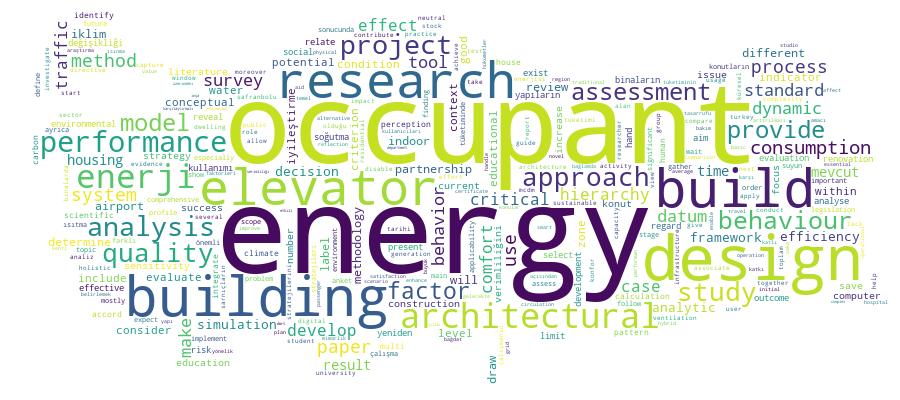
Competency Cloud
20 results
Scholarly Output Search Results
Now showing 1 - 10 of 20
Article Citation - WoS: 16Citation - Scopus: 24Architectural Design Quality Assessment Based on Analytic Hierarchy Process: a Case Study (1)(Middle East Technical Univ, 2014) Gultekin, A. Tanju; Prins, Matthijs; Topcu, Y. Ilker; Harputlugil, TimucinConference Object Re-Thinking of Energy Consumption Classification by the Patterns of Occupant Behaviour in Dwellings: a Conceptual Framework(Free University of Bozen Bolzano, 2015) Harputlugil, G.U.; Harputlugil, Timuçin; Harputlugil, T.; Harputlugil, Gülsu; MimarlıkThe aim of this paper is to present the conceptual framework of a TUBİTAK funded project titled "Developing a New Methodology to Improve Housing Quality in Turkey Based on Effects of Occupant Behavior on Energy and Comfort of the Dwellings". Although the objective of the project is the development of new methodologies and tools to be used for the definition of effects of behavior profiles of housing occupants on the energy consumption and usage of this knowledge for building new houses and renovation of existing buildings, here the first step of research has been executed. By defining sensitivity of occupant behavior on energy consumption, it is planned to classify different models of occupant behavior. With data provided, the aim is to develop an "occupant behavior labeling" which rates occupants instead of buildings. To provide the mentioned data, sensitivity analysis of existing occupant behavior will be analysed based on the Monte Carlo Methodology. This methodology is one of the most used methodologies to analyse accurate distribution of possible outputs relied on inputs based on probability. Inputs for this research are (1) number of occupants for each space (for weekdays and weekend) (2) behaviour for ventilation (Window open/closed and mechanical ventilation on/off) (3) control of heating systems (radiator on/off and/or thermostat degree). These data will be provided with survey and data logging of chosen a house occupant group. As a consequence of the research, the aim is not only to rate the behavior of housing occupants but also determine occupancy groups/labels. With this approach, based on occupant's behavior labeling, the aim is to realize fast and affective applications for renovation of existing buildings. Moreover, by evaluation/assessment of houses which will be designed in the future based on determined occupant profiles allow to produce high performance dwellings. © 2015 by Bozen-Bolzano University Press Free University of Bozen-Bolzano All rights reserved.Article Identifying Critical Success and Risk Factors of Airport Projects in Turkey Based on Public-Private Partnership(2019) Ramadhan Mohammed, Ali Omar; Harputlugil, TimuçinPublic-Private Partnership (PPP) is a significant procurement method for providing public service; in particular, for airport projects which constitute the most capital-demanding infrastructures with high level of risks. . Following extensive systematic literature review, Critical Success Factors (CSF), and Risk Factors (RF) were gathered based on a questionnaire for professionals and experts for PPP airport projects in Turkey, 162 experts of which 67 of them responded. Key Performance Indicators are grouped with factor analysis test based on the most important CSFs and risk factors identified within the scope of the paper.Article Citation - WoS: 1Citation - Scopus: 1Building Occupant Energy Labels (Oel): Capturing the Human Factors in Buildings for Energy Efficiency(Mdpi, 2025) Harputlugil, Timucin; de Wilde, PieterOccupancy is one of the primary contributors to the energy performance gap, defined as the difference between actual and predicted energy usage, in buildings. This paper limits its scope to residential buildings, where occupant-centric consumption often goes unaccounted for in standard energy metrics. This paper starts from the hypothesis that a simple occupant energy efficiency label is needed to capture the essence of occupant behaviour. Such a label would help researchers and practitioners study a wide range of behavioural patterns and may better frame occupant interventions, potentially contributing more than expected to the field. Focusing on the residential sector, this research recognises that the complexity of occupant behaviour and its links to different scientific calculations requires that researchers deal with several intricate factors in their building performance assessments. Moreover, complexity arising from changing attitudes and behaviours-based on building typology, social environment, seasonal effects, and personal comfort levels-further complicates the challenge. Starting with these problems, this paper proposes a framework for an occupant energy labelling (OEL) model to overcome these issues. The contribution of the paper is twofold. Firstly, the literature is reviewed in depth to reveal current research related to occupant behaviour for labelling of humans based on their energy consumption. Secondly, a case study with energy simulations is implemented in the UK, using the CREST tool, to demonstrate the feasibility and potential of OEL. The results show that labelling occupants may help societies reduce building energy consumption by combining insights from energy statistics, surveys, and bills gathered with less effort, and can assist decision-makers in determining the best match between buildings and occupants. While the focus of this study is on residential buildings, future research is recommended to explore the applicability of OEL in office environments, where occupant behaviour and energy dynamics may differ significantly.Article An investigation on The Effect of Drawing Techniques towards Students’ Performance and Perception in Architectural Education.(2018) Harputlugil, Timuçin; Çankaya Topak, Sıla; Özkan Öztürk, NurEmerging technologies allow digital production to be used within the initial stages of architectural design. The design process, in which drawing is the main tool, is affected with the rapid increase of digital production in the building sector and increasing awareness on digital drawing and production/fabrication is an undeniable fact of 21st century. In this context, the article investigates the status of hand (manual) and computer (digital) based drawings in architectural education; the students' perceptions and its effects on their performances. A case study -within the context of the Construction Systems II course given at the Architecture Department of Çankaya University-has been conducted to evaluate/quantify the students’ perceptions in order to demonstrate the advantages and disadvantages of hand and computer based drawings. Positive correlations of the familiarity to the drawing tool with easy correction of mistakes and relation of familiarity to the drawing tool with time management is observed. Based on the research; there is not a significant difference between hand based or computer based tools regarding spent time for the work in student practices; however, the process regarding revision, correction, or composition of drawing decreases time spent in computer aided drawing. Consequentlyit has been noticed that as the capability in drawing tool increased, the class performance of students increased too. The outcomes of the case study based on observations, evaluation, questionnaires and analysis covering an academicterm, are discussed in detail within the scope of the article.Conference Object Conceptual framework for potential implementations of multi criteria decision making (MCDM) methods for design quality assessment(2011) Harputlugil, Timuçin; Prins, Matthijs; Gültekin, A. Tanju; Topçu, İlkerArchitectural design can be considered as a process influenced by many stakeholders, each of which has different decision power. Each stakeholder might have his/her own criteria and weightings depending on his/her own perspective and role. Hence design can be seen as a multi-criteria decision making (MCDM) process. Considering architectural design, its evaluation and quality assessment within a context of MCDM is not regularly performed within building processes. The aim of the paper is to find/adapt proper methodologies of MCDM, used in other domains for assessment of design quality, adapt them to the construction domain and test their applicability. Current tools (for instance DQI, DEEP, AEDET, HQI, LEED, BREEAM, BQA) for quality assessment will be reviewed and compared with several MCDM methods (ie. AHP, ANP, PROMETHEE, SAW AND TOPSIS). Advantages and disadvantages of gathered outcomes from comparisons for assessment and applicability within architectural design will be discussed. Finally reflections on the outcomes will be provided.Conference Object Citation - Scopus: 1Water and Carbon Neutral Buildings: Systemic Approaches and Hybrid Strategies(Institute of Physics, 2024) Violano, A.; Harputlugil, T.In order to achieve a real green transition in the design, construction and use of the built environment, especially in contemporary urban contexts, it is necessary to assess the water saving benefits combined with binding energy efficiency and climate neutrality targets in a holistic manner. This approach cannot focus on stand-alone requirements. Special emphasis is placed on technological solutions that transform energy and water consumption from negative to positive at all stages of the life cycle, including construction and operation. The aim is not just to reduce expenditure, but to increase the effectiveness of the savings through an effective and cyclical approach over the long term. This paper presents the results of a research project that develops a set of integrated indicators in accordance with the Itaca Protocol standard, UNI/PdR Practice 13.0:2019, with the introduction of elements from the Level(s). The environmental indicator system is designed to simultaneously assess the requirements of water-neutral and carbon-neutral construction, in line with EU recommendations C/2021/2279 and C/2021/9332. The hybrid water-energy strategies used in the application of this system are evaluated in terms of their potential to achieve the aforementioned goals. This approach, illustrated by best practice examples, aims to provide a holistic assessment of the environmental performance of integrated buildings in contemporary urban contexts, taking into account both water efficiency and carbon reduction. The objective is to guide the technological design and construction of sustainable buildings, promoting a synergetic approach to water and carbon footprint management, starting from the case study of a building in Palermo. © Published under licence by IOP Publishing Ltd.Article Tarihi Şehirlerde Sarnıçların Yeniden Kullanımı Üzerine Bir Araştırma: Safranbolu Örneği(2025) Harputlugil, Timuçin; Kahyaoğlu, İremBu çalışma, su kaynaklarının hızla tükenmesi, nüfus artışı, küresel ısınma, iklim değişikliği ve bilinçsiz su kullanımı gibi etkenlerle artan su talebi sorunlarını ele alan varsayımsal bir senaryoyu incelemektedir. Tarihi dokusu koruma altına alınmış mimarisiyle tanınan Safranbolu kenti, bu sorunları örneklemek üzere bir vaka çalışması olarak seçilmiştir. Araştırma, mevcut sarnıçların uyarlanarak yeniden kullanımının binalarda su verimliliğini artırma potansiyelini değerlendirmektedir. Literatür taraması, iklim değişikliği ve nüfus artışının su talebini artırarak su kaynaklarının miktarını ve kalitesini olumsuz etkilediğini göstermiştir. Su tasarruflu uygulamalar ve atık suyun geri dönüşümünün artırılması, su verimliliğini geliştirmek için etkili stratejiler olarak belirlenmiştir. Ayrıca, Safranbolu gibi kentlerde bol miktarda bulunan sarnıçlar ve diğer tarihî su yapılarının yeniden kullanımı, su verimliliği hedeflerine ulaşmada ek bir potansiyel sunabilir. Ancak bu yaklaşımın uygulanabilirlik ve teknik boyutları çalışmanın kapsamı dışında bırakılmıştır. Safranbolu’da gerçekleştirilen saha çalışması iki aşamadan oluşmakta ve 11 önemli sarnıcın incelenmesi ve belgelenmesini de içermektedir. Buna ek olarak, kentteki 12 konak (pansiyon) ve 13 evden oluşan toplam 25 yapıdan günlük, aylık ve yıllık su tüketim verileri bir anket aracılığıyla toplanmıştır. Anket ayrıca bu binalarda suyun mekânsal kullanım türleri ile su tasarrufu sağlayan teknolojilerin uygulanmasına dair önemli bilgiler sunmuştur. Ön bulgular, bu 25 binada tüketilen suyun, gri suyun yeniden kullanımı ve sınırlı yağmur suyu hasadı ile, yerel sarnıçlarda kısmen yönetilebileceğini, depolanabileceğini ve arıtılabileceğini göstermektedir. Ancak bu yaklaşım, ekonomik, teknik ve bakım boyutlarını kapsamayan teorik bir çerçevedir. Tüm kısıtlara rağmen, sarnıçların yeniden kullanımı hem tarihî su yapılarının korunmasına hem de kültürel miras alanlarında daha sürdürülebilir bir su yönetimine katkı sağlayabilir.Article A Research on Comparison of Elevator Traffic Analysis Methods in Educational Buildings(Gazi Univ, Fac Engineering Architecture, 2023) Harputlugil, Timucin; Deligoez, DostcanPurpose: Regarding elevator design in educational buildings; It is aimed to investigate the legal framework, to integrate dynamic simulation programs to design process, to compare traditional and dynamic simulation methods, to evaluate the adequacy of elevator features specified in the legislation and to determine the optimum scenarios according to the minimum requirements.Theory and Methods: Based on the findings of the literature review, which examines the issue of elevator traffic analysis together with the legislation and regulations, the carrying capacities of the elevators in the educational buildings designed by the Ministry of National Education (MNE) are tested. The stability of the system is tested by analyzing the conditions where only the disabled, disabled and building workers can be used together and all building users can use the elevators with the dynamic simulation method (with Elevate Software). The limits of the system are determined based on the waiting times during the peak usage periods. The findings of the study are evaluated according to the waiting times determined by CIBSE Guide D and the Chamber of Mechanical Engineers followed by the discussion of the outcomes.Results: The issue of elevator design has been overlooked in educational buildings, and a comprehensive elevator traffic analysis method has not been defined. For the effective use of all occupants, elevator design should be handled comprehensively with considering potentials of dynamic simulation method.Conclusion: According to the findings of the study, it is noted that the number and capacity of elevators in the legislation for educational buildings are determined only for minimum conditions and for disabled users. In addition, the legislation (considering calculation methodology) is not specific for educational buildings but related with buildings in general with public use. Considering the occupants, and their profiles of the educational buildings, a more comprehensive traffic analysis with the dynamic simulation method may enable the elevators to be designed and to be used more efficiently.Master Thesis Improvement of Building Envelopes of Houses in Hot and Dry Climate Regions According To Climate Change: the Case of Baghdad(2024) Al-Azzawi, Aya Layth Abdulhadi; Harputlugil, Timuçinİklim değişikliği ve küresel ısınma, son yıllarda hem akademik çalışmalar hem de hükümetler ve uluslararası örgütler tarafından büyük bir ilgiyle ele alınan konular arasındadır. Eğer gerekli önlemler alınmazsa, küresel sıcaklıkların 2040 yılına kadar mevcut ortalamalara göre 1,5°C artacağı ve 21. yüzyılın sonunda ise bu artışın 4°C'yi aşabileceği öngörülmektedir. Hükümetler arası İklim Değişikliği Paneli'nin (IPCC) Altıncı Değerlendirme Raporu'na (AR6) göre, binaların toplam enerji tüketiminin yaklaşık %30'u bu binaların ısıtma ve soğutma sistemlerine yönelik harcanmaktadır (Kaihoul vd. 2021:43). Bu bağlamda, mevcut binaların enerji verimliliğini artırmak ve enerji standartlarına uygun hale getirmek, en önemli konular arasında yer almaktadır. Mevcut binaların enerji tüketimi açısından göz ardı edilmesi veya yıkılması yerine, bu yapıların enerji verimliliğini artıracak iyileştirme, onarım ve bakım çalışmalarının yapılması hem günümüzde hem de gelecekte enerji tüketiminin azaltılmasına katkı sağlayacaktır. Bu çalışmada, özellikle sıcak ve kuru iklim bölgelerinde yer alan konut yapıları incelenmekte, Bağdat kenti örnek vaka olarak ele alınmaktadır. Çalışma, bölgenin iklim verilerinin toplanması, mevcut yapıların iklim değişikliğine karşı dayanıklılıklarının artırılması ve bu yapıların performansının iyileştirme stratejileri kapsamında değerlendirilmesine odaklanmaktadır. Bu çalışmanın temel amacı, Bağdat şehrindeki mevcut tarihi ve çağdaş az katlı konutların enerji performanslarını ve yapı kabuklarını belirlemek, ayrıca iklim değişiklikleri sonucunda bu binaların enerji verimliliğini analiz etmektir. Çalışma, iyileştirme stratejilerini uyguladıktan sonra aynı konutların enerji performanslarının karşılaştırmalı analizini de hedeflemektedir. Bu bağlamda, Bağdat'ta farklı dönemlerde inşa edilmiş ve enerji verimliliği açısından farklı uygulamalara sahip dört farklı tipolojideki az katlı konutlar incelenmektedir. Amacın merkezinde, mevcut konutların yapı kabuğundaki ısı kayıplarını veya kazanımlarını azaltmak için en etkili iyileştirme stratejilerini belirlemek yer almaktadır. Çalışmanın yöntemi, geniş kapsamlı bir kaynak taramasının ardından, mevcut yapıların kabuğunu, kullanılan malzemeleri ve soğutma stratejilerini analiz eden simülasyon çalışmalarına dayanmaktadır. Simülasyonlar sonucunda önerilen iyileştirme stratejileri karşılaştırmalı olarak değerlendirilmiş ve performans sonuçları analiz edilmiştir. Elde edilen sonuçlara göre, mevcut konutların ısıtma ve soğutma enerji verimliliğini iyileştirme ve yenileme çalışmalarıyla artırmanın mümkün olduğu anlaşılmıştır. Her bir yapıya uygulanan iyileştirme stratejileri sonucunda, yıllık birincil ısıtma enerjisi tüketiminde %77, soğutma enerjisi tüketiminde %40 ve toplam ısıtma ve soğutma enerjisi tüketiminde %40'a varan azalmalar sağlanmıştır. Bu araştırmanın nihai amacı, iklim değişikliğinin enerji performansı üzerindeki etkileri konusunda farkındalık yaratarak, gelecekte inşa edilecek yapıların temelini oluşturacak bilgi ve stratejileri sunmaktır.
