Bilgilendirme: Kurulum ve veri kapsamındaki çalışmalar devam etmektedir. Göstereceğiniz anlayış için teşekkür ederiz.
 

Özaydın, Selma

Loading...
Profile Picture
Name Variants
Ozaydin, S.
Ozaydin, Selma
Job Title
Dr. Öğr. Üyesi
Email Address
Main Affiliation
08.02. Çankaya Meslek Yüksekokulu
Çankaya Meslek Yüksekokulu
08. Meslek Yüksekokulları
01. Çankaya Üniversitesi
Status
Former Staff
Website
ORCID ID
Scopus Author ID
Turkish CoHE Profile ID
Google Scholar ID
WoS Researcher ID

Sustainable Development Goals

13

CLIMATE ACTION
CLIMATE ACTION Logo

0

Research Products

8

DECENT WORK AND ECONOMIC GROWTH
DECENT WORK AND ECONOMIC GROWTH Logo

0

Research Products

3

GOOD HEALTH AND WELL-BEING
GOOD HEALTH AND WELL-BEING Logo

0

Research Products

15

LIFE ON LAND
LIFE ON LAND Logo

0

Research Products

17

PARTNERSHIPS FOR THE GOALS
PARTNERSHIPS FOR THE GOALS Logo

0

Research Products

14

LIFE BELOW WATER
LIFE BELOW WATER Logo

1

Research Products

4

QUALITY EDUCATION
QUALITY EDUCATION Logo

0

Research Products

11

SUSTAINABLE CITIES AND COMMUNITIES
SUSTAINABLE CITIES AND COMMUNITIES Logo

0

Research Products

6

CLEAN WATER AND SANITATION
CLEAN WATER AND SANITATION Logo

0

Research Products

10

REDUCED INEQUALITIES
REDUCED INEQUALITIES Logo

0

Research Products

9

INDUSTRY, INNOVATION AND INFRASTRUCTURE
INDUSTRY, INNOVATION AND INFRASTRUCTURE Logo

0

Research Products

12

RESPONSIBLE CONSUMPTION AND PRODUCTION
RESPONSIBLE CONSUMPTION AND PRODUCTION Logo

0

Research Products

2

ZERO HUNGER
ZERO HUNGER Logo

0

Research Products

1

NO POVERTY
NO POVERTY Logo

0

Research Products

7

AFFORDABLE AND CLEAN ENERGY
AFFORDABLE AND CLEAN ENERGY Logo

1

Research Products

5

GENDER EQUALITY
GENDER EQUALITY Logo

0

Research Products

16

PEACE, JUSTICE AND STRONG INSTITUTIONS
PEACE, JUSTICE AND STRONG INSTITUTIONS Logo

0

Research Products
This researcher does not have a Scopus ID.
This researcher does not have a WoS ID.
Scholarly Output

18

Articles

11

Views / Downloads

1628/716

Supervised MSc Theses

0

Supervised PhD Theses

0

WoS Citation Count

6

Scopus Citation Count

27

WoS h-index

2

Scopus h-index

3

Patents

0

Projects

0

WoS Citations per Publication

0.33

Scopus Citations per Publication

1.50

Open Access Source

6

Supervised Theses

0

Google Analytics Visitor Traffic

JournalCount
2022 International Conference on Electrical and Computing Technologies and Applications, ICECTA 2022 -- 2022 International Conference on Electrical and Computing Technologies and Applications, ICECTA 2022 -- 23 November 2022 through 25 November 2022 -- Ras Al Khaimah -- 1855963
Open Journal of Modern Linguistics3
Avrupa Bilim ve Teknoloji Dergisi1
Fluctuation and Noise Letters1
Gazi Üniversitesi Mühendislik Mimarlık Fakültesi Dergisi1
Current Page: 1 / 3

Scopus Quartile Distribution

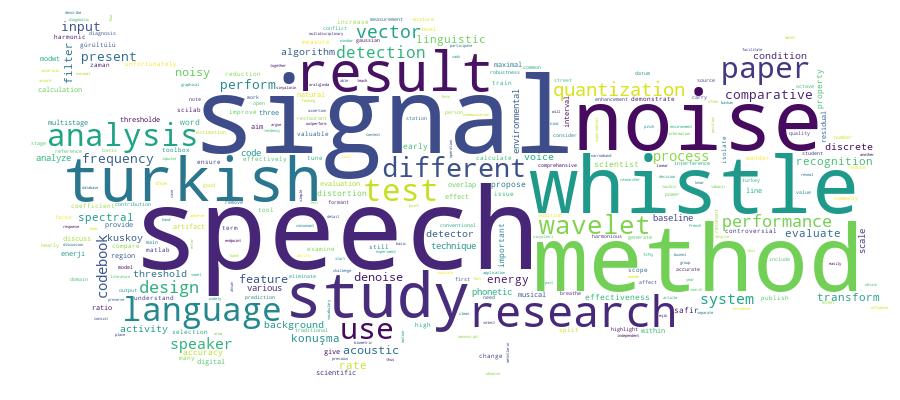
Competency Cloud

GCRIS Competency Cloud

Scholarly Output Search Results

Now showing 1 - 10 of 18
  • Conference Object
    Citation - Scopus: 9
    Speech Denoising With Maximal Overlap Discrete Wavelet Transform
    (Institute of Electrical and Electronics Engineers Inc., 2022) Ozaydin, S.; Alak, I.K.
    In this paper, the effectiveness of the maximum overlapping discrete wavelet transform (MODWT) method on denoising the speech signal is tested and examined. Ensuring the intelligibility of the speech signal in noisy environments by separating it from the noise is a widely researched topic today. On the other hand, being able to recover the original speech from the noisy signal with minimal distortion is a challenge due to the difficulties in removing the background noise. Numerous factors in environmental noise environments can interfere with the signal. In this study, the performance of some discrete wavelets transform methods is experimentally analyzed using different wavelet filters. The analysis program was carried out in the MATLAB environment. As the input noise speech signal, speech sounds containing different environmental background noises (train, car, station, plane, etc.) were analyzed. During the tests, these noisy input signals were filtered out from the speech signal by wavelet analysis. The input noisy speech signal is decomposed into wavelet coefficients with different thresholding methods. The reconstructed speech was compared by measuring the signal-to-noise ratio (SNR) values between the noisy input signal and the smoothed output signals. The scientific contributions of the study include a detailed comparative analysis of the performances of various wavelet methods against different background environmental noises. © 2022 IEEE.
  • Article
    Investigation of Factors Affecting Noise Robustness in Voice Activity Detectors
    (Gazi Univ, Fac Engineering Architecture, 2023) Ozaydin, Selma
    In this manuscript, some voice activity detectors (VADs) in the literature were examined in terms of factors affecting their robustness under different acoustic noise conditions and in this context, the changes in detection accuracy rates according to changing noise conditions were tested. In this scope, the effect of situations such as whether the threshold value used in the decision phase in VAD methods is fixed or adaptive, the analysis window is short or long, the use of more than one feature vector together has been evaluated and analyzed comparatively. While three of the four different VAD detectors examined in this manuscript use feature vectors within the short-term analysis window while generating the decision result, one decides according to the measurement result of long-term spectral vectors. The VAD detectors in the article have been tested using the NOIZEUS noisy speech database. Thus, the performance of the analyzed VADs has been evaluated under different acoustic conditions using an extensive database that has already taken place in the literature. During the testing of the analyzed VADs, different input noise speech signals with environmental background noises between [15-0dB] such as restaurant, car, street, or station were tested. Tests were carried out using objective test measurement methods and the detection accuracy rate of each VAD method was measured. The results showed that each method gave different endurance performance in adverse environmental conditions.
  • Article
    Comparative Analysis of Early Studies on Turkish Whistle Language and a Case Study on Test Conditions
    (2018) Özaydın, Selma
    This paper examines the early studies on Turkish Whistle Language and it argues that they have some controversial results. The study considers these issues need to be discussed and searched again in terms of linguistic and phonetic form. Unfortunately, there are few research studies on Turkish whistle language and most of them were performed nearly fifty years ago despite the fact that this language still has been used in Kuskoy region. Therefore, the findings of these early research studies could give valuable information to start to a new research study on the subject. The first scientific study on Turkish Whistle language was performed by a French scientist R.G. Busnel with his multidisciplinary research team in 1967. Some of this research’s results were published in the book. A Turkish scientist O. Baskan also participated in Busnel’s research group and published a paper on TWsL in 1968. However, some assertions such as people having a tendency to understand the Turkish whistle language with three vowels and three consonants have not been in the research results of R.G. Busnel. In addition, a Turkish scientist D. Aksan in Turkey had performed another research at Kuskoy region with his own team. Their test methods were different from the previous ones. This paper analyzes these research results on a comparative basis and presents the common and conflicted issues to discuss the uncertain points. The comparative evaluation of these past research studies aims to highlight the controversial position of the results on Turkish Whistle Language. In this scope, this paper opens a discussion about the selection of test conditions for an acoustic and linguistic analysis of the Turkish whistle language.
  • Conference Object
    Citation - WoS: 4
    Citation - Scopus: 11
    Design of a Text Independent Speaker Recognition System
    (Ieee, 2017) Ozaydin, Selma
    This paper presents the design of a text independent speaker recognition system based on Mel-Frequency Cepstrum Coefficients and Gaussian Mixture Models. HTK speech recognition toolkit is used in the design of speaker models. The system is aimed to use it as a biometric authentication system. The experiments were performed on speech data consist of 134 speakers from YOHO database for different training conditions. The increase of the proposed system performance is observed with the decrease of Equal Error Rate. Experiment results show that the system gives the best recognition performance for Gaussian mixture model with 64 mixtures.
  • Conference Object
    A complexity reduction method for joint MSVQ
    (2016) Özaydın, Selma
  • Conference Object
    A Graphical Speech Analysis Teaching Tool
    (Institute of Electrical and Electronics Engineers Inc., 2022) Ozaydin, S.
    The widespread use of digital speech processing in today's technologies causes many electronics and computer engineering students to need a basic background in these subjects. The paper describes a toolbox designed to support undergraduate or graduate level courses on speech processing. The proposed educational toolbox is designed as a virtual lab for basic operations in digital speech processing-based courses. This graphical user interface (GUI) based speech analysis algorithm is built with six main function modules, which are signal input, noise addition, up-sampling/down-sampling, time domain feature analysis, pitch detection and frequency domain analysis. The toolbox involves different operations for measuring important speech feature parameters such as pitch, energy, zero-crossing ratio, FFT and power spectrum of an input speech signal. The toolbox has also been developed to easily manipulate and add some other possible speech processing methods. It is thought that the tool will make it easier for students to understand the methods that form the basis of digital speech processing, increase the interest in the lesson with its visual outputs, and allow new methods to be added easily when desired thanks to its simple and modular structure. The main aim of this paper to show how such a tool facilitates students understanding of technical concepts introduced in speech courses. © 2022 IEEE.
  • Article
    Comparative Analysis of Early Studies on Turkish Whistle Language and a Case Study on Test Conditions
    (2018) Özaydın, Selma
    This paper examines the early studies on Turkish Whistle Language and it argues that they have some controversial results. The study considers these issues need to be discussed and searched again in terms of linguistic and phonetic form. Unfortunately, there are few research studies on Turkish whistle language and most of them were performed nearly fifty years ago despite the fact that this language still has been used in Kuskoy region. Therefore, the findings of these early research studies could give valuable information to start to a new research study on the subject. The first scientific study on Turkish Whistle language was performed by a French scientist R.G. Busnel with his multidisciplinary research team in 1967. Some of this research’s results were published in the book. A Turkish scientist O. Baskan also participated in Busnel’s research group and published a paper on TWsL in 1968. However, some assertions such as people having a tendency to understand the Turkish whistle language with three vowels and three consonants have not been in the research results of R.G. Busnel. In addition, a Turkish scientist D. Aksan in Turkey had performed another research at Kuskoy region with his own team. Their test methods were different from the previous ones. This paper analyzes these research results on a comparative basis and presents the common and conflicted issues to discuss the uncertain points. The comparative evaluation of these past research studies aims to highlight the controversial position of the results on Turkish Whistle Language. In this scope, this paper opens a discussion about the selection of test conditions for an acoustic and linguistic analysis of the Turkish whistle language.
  • Conference Object
    Citation - Scopus: 1
    An Isolated Word Speaker Recognition System
    (Institute of Electrical and Electronics Engineers Inc., 2017) Ozaydin, S.
    The paper presents a design of an isolated word speaker recognizer system by using the Hidden Markov Model. HTK toolkit is used as a design tool. The system is operated on a closed set of speakers and with a limited vocabulary of words. Digit utterances from one to ten with ten speakers (7 male, 3 female) are used as dataset in the system. It consists of isolated words that are separated by silences. Each speaker reads each word ten times. Six of them are used in training and the remaining are used in the test phase. The Mel cepstral coefficients are used in order to design the acoustic features and HMM models are constructed. A threshold calculation is performed for each speaker. After threshold adjustment, tests are performed for the performance evaluation and accuracy rates are calculated for each user. The system resulted in changing levels of recognition accuracy for each speaker and each word. © 2017 IEEE.
  • Conference Object
    Citation - Scopus: 2
    Design of a Voice Activity Detection Algorithm Based on Logarithmic Signal Energy
    (Institute of Electrical and Electronics Engineers Inc., 2022) Ozaydin, S.
    This article presents a new method for calculating the signal energies of speech segments in voice activity detection algorithms. In the study, the μ-law signal compression method is adapted to calculate short-term signal energies. A simple voice activity detection (VAD) algorithm is designed to demonstrate the effectiveness of the proposed method. The same VAD algorithm was also run with two different conventional energy calculation formulas and the performance of each VAD was evaluated using time-domain short-time energy features. The G729 standard VAD algorithm was also used for performance comparison. During the test of the analyzed detectors, many kinds of input speech signals with various types of background environmental noise, such as restaurants, vehicles, and streets, were tested. Using the new energy calculation method, the VAD detector has improved detection accuracy compared to VAD detectors based on the other two energy methods and was able to effectively identify voice-active regions even in noisy conditions at low SNR levels. The results revealed that the VAD detector designed with the proposed new energy calculation formula outperforms traditional energy-based voice activity detection methods and provides noticeable increases in detection rate even under adverse conditions. © 2022 IEEE.