
Defterli, Özlem
Loading...
Profile URL
Name Variants
Defterli, Ö.
Defterli, Ozlem
Özlem, Defterli
Defterli, Ö
Defterli, O.
Defterli, Z
Defterli, O
Defterli, Ozlem
Özlem, Defterli
Defterli, Ö
Defterli, O.
Defterli, Z
Defterli, O
Job Title
Doç. Dr.
Email Address
defterli@cankaya.edu.tr
Main Affiliation
02.02. Matematik
Matematik
02. Fen-Edebiyat Fakültesi
01. Çankaya Üniversitesi
Matematik
02. Fen-Edebiyat Fakültesi
01. Çankaya Üniversitesi
Status
Current Staff
Website
ORCID ID
Scopus Author ID
Turkish CoHE Profile ID
Google Scholar ID
WoS Researcher ID
Files
Sustainable Development Goals
 1
1NO POVERTY
1
Research Products
 2
2ZERO HUNGER
0
Research Products
 3
3GOOD HEALTH AND WELL-BEING
6
Research Products
 4
4QUALITY EDUCATION
0
Research Products
 5
5GENDER EQUALITY
0
Research Products
 6
6CLEAN WATER AND SANITATION
0
Research Products
 7
7AFFORDABLE AND CLEAN ENERGY
0
Research Products
 8
8DECENT WORK AND ECONOMIC GROWTH
1
Research Products
 9
9INDUSTRY, INNOVATION AND INFRASTRUCTURE
0
Research Products
 10
10REDUCED INEQUALITIES
1
Research Products
 11
11SUSTAINABLE CITIES AND COMMUNITIES
1
Research Products
 12
12RESPONSIBLE CONSUMPTION AND PRODUCTION
0
Research Products
 13
13CLIMATE ACTION
0
Research Products
 14
14LIFE BELOW WATER
0
Research Products
 15
15LIFE ON LAND
0
Research Products
 16
16PEACE, JUSTICE AND STRONG INSTITUTIONS
0
Research Products
 17
17PARTNERSHIPS FOR THE GOALS
0
Research Products

Documents
32
Citations
1213
h-index
15

Documents
0
Citations
0

Scholarly Output
40
Articles
23
Views / Downloads
3478/671
Supervised MSc Theses
1
Supervised PhD Theses
0
WoS Citation Count
991
Scopus Citation Count
1024
Patents
0
Projects
0
WoS Citations per Publication
24.78
Scopus Citations per Publication
25.60
Open Access Source
11
Supervised Theses
1
| Journal | Count |
|---|---|
| Journal of Vibration and Control | 2 |
| International Journal of Modeling, Simulation, and Scientific Computing | 2 |
| Romanian Reports in Physics | 2 |
| Computers & Mathematics with Applications | 2 |
| Journal of Low Frequency Noise, Vibration and Active Control | 2 |
Current Page: 1 / 7
Scopus Quartile Distribution
Competency Cloud
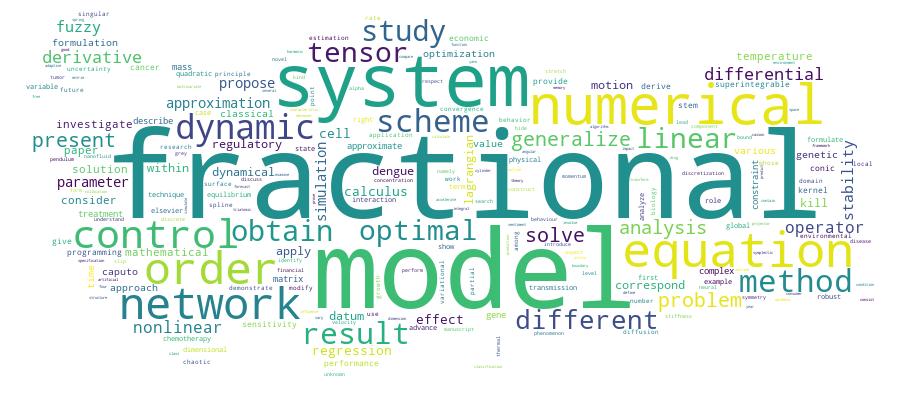
40 results
Scholarly Output Search Results
Now showing 1 - 10 of 40
Conference Object Citation - Scopus: 2Stability Analysis of Covid-19 Via a Fractional Order Mathematical Model(Springer Science and Business Media Deutschland GmbH, 2022) Defterli, O.; Baleanu, D.; Arshad, S.; Wali, M.In this work, a four compartmental SEIR model is constructed for the transmission of the Novel Coronavirus infectious disease using Caputo fractional derivative. The disease-free equilibrium and endemic equilibrium are investigated with the stability analysis correspondingly. The solution at different fractional orders is obtained using the Laplace Adomian Decomposition method. Furthermore, the dynamics of the proposed fractional order model are interpreted graphically to observe the behaviour of the spread of disease by altering the values of initially exposed individuals and transmission rate. © 2022, The Author(s), under exclusive license to Springer Nature Switzerland AG.Article Citation - WoS: 7Citation - Scopus: 7A Numerical Framework for the Approximate Solution of Fractional Tumor-Obesity Model(World Scientific Publ Co Pte Ltd, 2019) Defterli, Ozlem; Shumaila; Arshad, Sadia; Baleanu, DumitruIn this paper, we have proposed the efficient numerical methods to solve a tumor-obesity model which involves two types of the fractional operators namely Caputo and Caputo-Fabrizio (CF). Stability and convergence of the proposed schemes using Caputo and CF fractional operators are analyzed. Numerical simulations are carried out to investigate the effect of low and high caloric diet on tumor dynamics of the generalized models. We perform the numerical simulations of the tumor-obesity model for different fractional order by varying immune response rate to compare the dynamics of the Caputo and CF fractional operators.Article Citation - WoS: 30Citation - Scopus: 36The New Robust Conic Gplm Method With an Application To Finance: Prediction of Credit Default(Springer, 2013) Weber, Gerhard-Wilhelm; Cavusoglu, Zehra; Defterli, Ozlem; Ozmen, AyseThis paper contributes to classification and identification in modern finance through advanced optimization. In the last few decades, financial misalignments and, thereby, financial crises have been increasing in numbers due to the rearrangement of the financial world. In this study, as one of the most remarkable of these, countries' debt crises, which result from illiquidity, are tried to predict with some macroeconomic variables. The methodology consists of a combination of two predictive regression models, logistic regression and robust conic multivariate adaptive regression splines (RCMARS), as linear and nonlinear parts of a generalized partial linear model. RCMARS has an advantage of coping with the noise in both input and output data and of obtaining more consistent optimization results than CMARS. An advanced version of conic generalized partial linear model which includes robustification of the data set is introduced: robust conic generalized partial linear model (RCGPLM). This new model is applied on a data set that belongs to 45 emerging markets with 1,019 observations between the years 1980 and 2005.Article Citation - WoS: 138Citation - Scopus: 147Thermal and Velocity Slip Effects on Casson Nanofluid Flow Over an Inclined Permeable Stretching Cylinder Via Collocation Method(Pergamon-elsevier Science Ltd, 2018) Soomro, Feroz Ahmed; Haq, Rizwan Ul; Wang, W.; Defterli, Ozlem; Usman, M.; Ul Haq, RizwanThe main emphasis of present work is to investigate the velocity and thermal slip effects on Casson nano fluid with heat and mass transfer phenomena over an inclined permeable stretching cylinder. The cylinder is subject to transverse magnetic field. Buongiorno's model is adapted to study the Brownian motion and thermphoresis effects which play a dominant role in nanofluid. Governing set of equations are derived in terms of partial differential equations for Casson nanofluid model, consisting continuity, momentum, energy and concentration equation which are transformed into set of coupled nonlinear ordinary differential equations using similarity transformation. The numerical solution is obtained using collocation method. The literature survey shows that the present problem has not been studied before. Physical quantities of interest are nanofluid velocity, temperature, concentration, skin friction coefficient, Nusselt number and Sherwood number which are analyzed through graphs against the emerging physical parameters. It is found that Nb and Nt play a dominant role within the thermal and concentration boundary layer regions. In the same manner, suction parameter and both velocity and thermal slip parameters depicts the dynamic effects in the entire domain of stretching surface of the cylinder. (C) 2018 Elsevier Ltd. All rights reserved.Article Citation - WoS: 104Citation - Scopus: 119Fractional Treatment: an Accelerated Mass-Spring System(Editura Acad Romane, 2022) Defterli, Ozlem; Baleanu, Dumitru; Baleanu, Dumitru; Defterli, Özlem; Jajarmi, Amin; Sajjadi, Samaneh Sadat; Alshaikh, Noorhan; Asad, Jihad H.; MatematikThe aim of this manuscript is to study the dynamics of the motion of an accelerated mass-spring system within fractional calculus. To investigate the described system, firstly, we construct the corresponding Lagrangian and derive the classical equations of motion using the Euler-Lagrange equations of integer-order. Furthermore, the generalized Lagrangian is introduced by using non-integer, so-called fractional, derivative operators; then the resulting fractional Euler-Lagrange equations are generated and solved numerically. The obtained results are presented illustratively by using numerical simulations.Article Citation - WoS: 15Citation - Scopus: 14Comparative Analysis of Fractional Order Dengue Model With Temperature Effect Via Singular and Non-Singular Operators(Pergamon-elsevier Science Ltd, 2021) Defterli, OzlemIn this work, we generalize a (deterministic) mathematical model that anticipates the influence of temperature on dengue transmission incorporating temperature-dependent model parameters. The motivation comes by the epidemiological evidence and several recent studies clearly states fluctuations in temperature, rainfall, and global climate indexes are determinant on the transmission dynamic and epidemic behavior of dengue virus that causes deadly diseases with incidence rates significantly risen worldwide in the past decade. Taking into account the importance of the subject in nowadays and the diversity of fractional calculus operators in mathematical modeling of complex real-world systems, in this paper we investigated the importance of the new model based on Mittag-Leffler kernel as being non-singular kernel. The sensitivity analysis of the generalized model is newly investigated. Numerical simulations are carried out in a comparative sense within the temperature fluctuations for both singular and non-singular fractional operators of different orders. (c) 2021 Elsevier Ltd. All rights reserved.Conference Object Citation - WoS: 1Citation - Scopus: 1Killing-Yano Tensors and Superintegrable Systems(inst Physics Acad Sci Czech Republic, 2004) Defterli, Ö; Baleanu, DKilling-Yano (KY) and Killing tensors of the four types of metrics, that represent the two-dimensional spaces given in Darboux's classification, are obtained. It is proved that all spaces admit dual manifolds and their KY tensors are calculated.Conference Object Projector Quantization Method of Systems With Linearly Dependent Constraints(inst Physics Acad Sci Czech Republic, 2005) Defterli, O; Baleanu, DThe local free coordinates on the constraint surface are obtained within symplectic projector method when the constraints are linearly dependent. One example is investigated in details.Article Citation - WoS: 101Citation - Scopus: 115On a Nonlinear Dynamical System With Both Chaotic and Nonchaotic Behaviors: a New Fractional Analysis and Control(Springer, 2021) Jajarmi, Amin; Defterli, Ozlem; Baleanu, Dumitru; Sajjadi, Samaneh SadatIn this paper, we aim to analyze the complicated dynamical motion of a quarter-car suspension system with a sinusoidal road excitation force. First, we consider a new mathematical model in the form of fractional-order differential equations. In the proposed model, we apply the Caputo-Fabrizio fractional operator with exponential kernel. Then to solve the related equations, we suggest a quadratic numerical method and prove its stability and convergence. A deep investigation in the framework of time-domain response and phase-portrait shows that both the chaotic and nonchaotic behaviors of the considered system can be identified by the fractional-order mathematical model. Finally, we present a state-feedback controller and a chaos optimal control to overcome the system chaotic oscillations. Simulation results demonstrate the effectiveness of the proposed modeling and control strategies.Article Revealing Fractional Effects in an Asymmetric Two-Dimensional Oscillator through Variational Mechanics(SAGE Publications Ltd, 2026) Baleanu, Dumitru; Defterli, Ozlem; Asad, Jihad; Jajarmi, Amin; AlShaikh Mohammad, Noorhan F.The present study is an application of a generalized Lagrangian-Hamiltonian approach to the analysis of an asymmetric two-dimensional harmonic oscillator with the use of the Caputo fractional derivative. Fractional Euler-Lagrange and Hamiltonian equations were systematically developed and then solved numerically using a predictor-corrector version of the Adams-Bashforth-Moulton method. The results show that decreasing the value of the fractional order (alpha) generates a form of memory-based damping within the system that transforms the classical closed orbits of phase space into spiral inward trajectories and causes the total energy of the system to decrease according to a power law, regardless of whether there are any dissipative forces in the system. It was demonstrated that both the degree of coupling and the degree of asymmetry can cause the system to lose energy at different rates and to have different amounts of attenuation in each direction. It was also demonstrated that the model provides a smooth transition to classical conservative behavior as alpha approaches unity, which confirms the physical validity of this representation. This demonstrates that fractional variational mechanics provides a consistent and physically meaningful way to describe the transition from conservative to dissipative behavior for coupled oscillating systems that are governed by memory and non-local effects.
