
Klasra, Mushtaq Ahmad
Loading...

Profile URL
Name Variants
Klasra, Mushtaq
Klasra, MA
Klasra, M.A.
Klasra, MA
Klasra, M.A.
Job Title
Öğr. Gör.
Email Address
Main Affiliation
03.06. Uluslararası Ticaret ve Finansman
Uluslararası Ticaret ve Finansman
03. İktisadi ve İdari Birimler Fakültesi
01. Çankaya Üniversitesi
Uluslararası Ticaret ve Finansman
03. İktisadi ve İdari Birimler Fakültesi
01. Çankaya Üniversitesi
Status
Former Staff
Website
ORCID ID
Scopus Author ID
Turkish CoHE Profile ID
Google Scholar ID
WoS Researcher ID
Sustainable Development Goals
 1
1NO POVERTY
0
Research Products
 2
2ZERO HUNGER
0
Research Products
 3
3GOOD HEALTH AND WELL-BEING
2
Research Products
 4
4QUALITY EDUCATION
0
Research Products
 5
5GENDER EQUALITY
0
Research Products
 6
6CLEAN WATER AND SANITATION
0
Research Products
 7
7AFFORDABLE AND CLEAN ENERGY
0
Research Products
 8
8DECENT WORK AND ECONOMIC GROWTH
1
Research Products
 9
9INDUSTRY, INNOVATION AND INFRASTRUCTURE
1
Research Products
 10
10REDUCED INEQUALITIES
0
Research Products
 11
11SUSTAINABLE CITIES AND COMMUNITIES
0
Research Products
 12
12RESPONSIBLE CONSUMPTION AND PRODUCTION
0
Research Products
 13
13CLIMATE ACTION
0
Research Products
 14
14LIFE BELOW WATER
0
Research Products
 15
15LIFE ON LAND
0
Research Products
 16
16PEACE, JUSTICE AND STRONG INSTITUTIONS
0
Research Products
 17
17PARTNERSHIPS FOR THE GOALS
2
Research Products

This researcher does not have a Scopus ID.

This researcher does not have a WoS ID.

Scholarly Output
8
Articles
8
Views / Downloads
650/13
Supervised MSc Theses
0
Supervised PhD Theses
0
WoS Citation Count
23
Scopus Citation Count
38
Patents
0
Projects
0
WoS Citations per Publication
2.88
Scopus Citations per Publication
4.75
Open Access Source
1
Supervised Theses
0
| Journal | Count |
|---|---|
| Applied Economics | 1 |
| Aquaculture Economics and Management | 1 |
| International Journal of Social Economics | 1 |
| Journal of Applied Sciences | 1 |
| Quality & Quantity | 1 |
Current Page: 1 / 2
Scopus Quartile Distribution
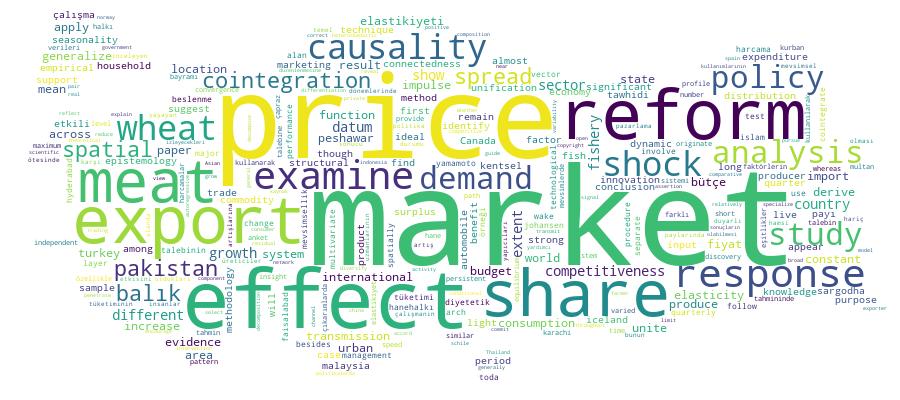
Competency Cloud
8 results
Scholarly Output Search Results
Now showing 1 - 8 of 8
Article Citation - WoS: 4Citation - Scopus: 6Et ve Balık Eti Hanehalkı Talebinin Mevsimselliği: Bir Kentsel Alan Örneği(Tubitak Scientific & Technological Research Council Turkey, 2005) Klasra, Mushtaq Ahmad; Fidan, HalilBu çalışma, Almost Ideal Demand System (AIDS)'i kullanarak, farklı mevsimlerde et ve balık için hane halkı talebine etkili faktörlerin tahmininde çıkarımlarda bulunmaktadır. Anket verileri kullanılarak, bütçe payı, talebin fiyat elastikiyeti, çapraz elastikiyet ve balık ve et için harcamalar, eşitlikler sistemi ile tahmin edilmiştir. Özellikle, Kurban Bayramı dönemlerinde bütçe paylarında artış olması durumu et ve balık tüketiminin mevsimsel etkisini inceleyen bu çalışmanın temel sonucu olmuştur. Bunun ötesinde, kentsel alanda yaşayan insanlar, hamsi hariç, fiyat artışlarına karşı duyarlı oldukları bulunamamıştır. Bu çalışma, politika yapıcıları, üreticiler ve pazarlama uzmanlarının izleyecekleri politikalarda etkili kaynak kullanımlarının düzenlenmesine, bu sonuçların onlara yardımcı olabilmesi bakımından önemlidir.Article Seasonality in household demand for meat and fish: Evidence from an urban area(Scientific Technical Research Council Turkey-Tubitak, 2005) Fidan, Halil; Klasra, Mushtaq AhmadThis paper, using the Almost Ideal Demand System (AIDS), derives estimates of factors influencing household demand for meat and fish during different seasons. Using primary data obtained from the survey, a system of equations pertaining to budget share, demand elasticities of own price, cross price and expenditure for meat and fish was estimated. The main conclusion is that there are seasonal effects on the consumption of meat and fish. In particular, during the Muslim Festival of Sacrifice the budget share of meat increases. Further, people living in urban areas were not sensitive to price increases except for in anchovy. This study is of importance to policy makers, producers and marketing strategists alike, as this conclusion will help them to design their respective policies to use resources more efficientlyArticle Citation - Scopus: 10Competitiveness of Major Exporting Countries and Turkey in the World Fishery Market: a Constant Market Share Analysis(2005) Fidan, H.; Klasra, M.A.The purpose of this study is to examine whether and to what extent the shares of selected countries' fishery exports in the world markets reflect their international competitiveness. The Constant Market Share (CMS) model, which decomposes export growth into some broad components (i.e., structural effects, market effects, commodity effects and competitive effects), is applied to examine this issue. The results of decomposition analysis revealed that structural factors have been more significant in explaining the growth of exports. The growth effects, though, appeared positive for each country, the exports of open economies like Canada, the United States, Iceland and Turkey benefited more from the growth of world exports. The analysis of commodity composition and market effects suggests that countries like Canada, the United States, Iceland and Turkey were pursuing the product differentiation policy and were penetrating in those markets, which have been growing relatively faster. These countries remained committed throughout the sample period (i.e., 1980-2000) to export their diversified products in fast-growing markets. The analysis of competitiveness effects, which are derived as a residual, show that Norway, Spain, the United States, Indonesia, Thailand, sChile and China were strong fishery exporters and increased their competitiveness during the sample period. Copyright © 2005 IAAEM.Article Market Reforms, Spatial Price Spread and Market Connectedness: Evidence From Wheat Markets in Pakistan(2006) Klasra, M.A.This study, while using the data from 8 wheat markets of Pakistan, examines the extent of spatial price spread and market connectedness during reform and pre-reform periods. It is found that market reforms reduced the spatial price spread in 21 of 28 pairs of markets during reform period. The general view that more near the two markets are, stronger will be the co-movement of their prices, did not get support from empirical evidences. By encouraging the private sector and also limiting the extent of government intervention in the trading activity, correct price signals can be transmitted down to the marketing channel and can guide the farmers to specialize according to their comparative advantages. © 2006 Asian Network for Scientific Information.Article Dynamics of Wheat Prices in the Wake of Market Reforms: the Case of Pakistan(Springer, 2006) Kiral, T; Klasra, MAUsing Autoregressive Conditional Heteroskedastic (ARCH) method, this paper examines the effects of market reforms on the distribution of real mean prices and their variability before and after reforms. It is found that market-oriented reforms benefited producers and consumers alike. Empirical evidences, generally, support theoretical assertion that mean prices decline in most urban areas and increase in those markets that are located in surplus producing areas. The results also showed that market reforms lead to more price volatility.Article Citation - WoS: 5Citation - Scopus: 6Knowledge-Induced Technological Change a Study Involving the Automobile Innovation in Malaysia With Layers of Techniques(Emerald Group Publishing Ltd, 2006) Azid, Toseef; Klasra, Mushtaq; Choudhury, MasudulPurpose - To apply the Tawhidi epistemology in the automobile industry as the paradigm of the Islamic socio-scientific order in terms of its inherent knowledge-centered worldview. Design/methodology/approach - The concepts of unity and unification of knowledge in a system-wide sense are analytically developed in the framework of shuratic process or equivalently as the interactive, integrative and evolutionary process-oriented methodology (IIE). Findings - The analytical conceptualization is derived in the light of Qur'anic rules (ahkam) and recommended that policies, programs and instruments would jointly promote the development of mutual profitability and address the social milieu as well. Research limitations/implications - Tawhidi unification methodology of extensive participation and linkage can be applied widely. Originality/value - Certain policy recommendations in the light of the shari'ah precepts of this case study can be made.Article Citation - WoS: 13Citation - Scopus: 15Import-Content of Exports and J-Curve Effect(Routledge Journals, Taylor & Francis Ltd, 2010) Yazici, Mehmet; Klasra, Mushtaq AhmadThis article investigates how the response to devaluation of trade balance is affected, compared to J-curve hypothesis, by the presence of imported inputs in the production of exports. Using first the Almon lag technique and then the cointegration and the generalized impulse response function analysis, the J-curve effect is examined in two sectors of Turkish economy (manufacturing and mining), which use imported inputs at different rates. Based on the data covering the period from the first quarter of 1986 to the third quarter of 1998, our results indicate that in neither sector J-curve exists and that the violation of the J-curve effect is more severe in the sector with higher import content.Article Citation - WoS: 1Citation - Scopus: 1Cointegration, Causality and the Transmission of Shocks Across Wheat Market in Pakistan(Springer, 2009) Klasra, Mushtaq AhmadThis paper uses quarterly price data and examines the transmission of shocks across different spatially separated locations besides identifying causality among these locations. Johansen and Juselius's (Econ. Stat., 52, 160-210, 1990) multivariate cointegration procedure identified two cointegrating vectors among these locations. Following Toda and Yamamoto (J. Econom., 66, 225-250, 1995), causality tests showed only one bi-directional causality and it was between Peshawar and Hyderabad locations. Faisalabad and Sargodha appeared independent (i.e. exogenous) market locations in price discovery process. Peshawar market showed maximum (i.e. 5) number of significant links. The generalized impulse response functions, though, suggested similar (cyclical) pattern of responses across the markets, but their time profile, which provides insight into the system's speed of convergence to long run equilibrium path, varied with different level of extent and persistency. Responses to shock originating in consumption markets (i.e. Karachi, Peshawar and Lahore) remained short lived; whereas the shocks stemming from surplus wheat producing locations (i.e Multan, Sargodha and Faisalabad) produced long and more persistent responses.
